
The demo question is "Can the system recommend products?"
That is the easy one.
The hard question comes the Monday after launch:
"The buyer wants to push the new Ralph Lauren collaboration this week. How do we change what the system recommends by Friday?"
If the answer involves editing prompts, redeploying, or filing an engineering ticket, the recommender is not a system. It is a demo.
If the answer is "the merchandising team edits a config file and it takes effect on the next customer query", the recommender is something that can survive contact with a real retail operation.
The system in question is the conversational AI your customers interact with — the shopping assistant, the product recommender, the commerce chat agent. The label changes. The control question does not.
This article is about the gap between those two answers. The companion piece on what agentic commerce actually requires covers the architectural argument.
This one is narrower: the only control surface that matters week-to-week — the one the merchandising team uses.
Retail runs on overlapping cycles
Seasonality is the base rhythm. Heavy coats sell in November and December, not in June. Lightweight pieces move in spring. Holiday gifting compresses into a three-week window.
On top of that, monthly campaigns and collaborations anchor the calendar. New collections land. Partnerships launch. Sale windows open and close.
On top of that, weekly and daily events. New arrivals on Tuesday. A competitor drop on Thursday. Dead stock that needs to clear before the next buy. A buyer's priority that shifts overnight.
None of these are technology decisions. They are merchandising decisions — happening on three tempos at once.
If the shopping assistant cannot keep up with all three, the business team will route around it. Then they will replace it.
The model's accuracy is irrelevant if the assortment is stuck on last month's priorities — or last season's.
The question is not "how smart is the AI?" It is "how fast can the business change what it does?"
What the merchandising team actually needs to do in a week
Strip the technology away and the job is specific.
- Push a brand — a new collaboration, a strategic partner, a buyer's priority
- Retire a campaign — stop promoting something the moment the contract ends
- Surface new arrivals — products added this week should not be buried
- Move slow stock — nudge visibility toward items that need to clear
- Tilt the category mix — more emphasis on knits this month, less on outerwear
- Encode brand identity — permanent signals that distinguish streetwear from luxury, regardless of campaign
Every item on that list is a business decision.
Every one of them needs to take effect within days.
A recommender that can't be adjusted on any of these axes is a recommender the merchandising team will abandon.
Rules in a config, not prompts
The control surface is deliberately low-tech.
A single config file the system reloads on every request.
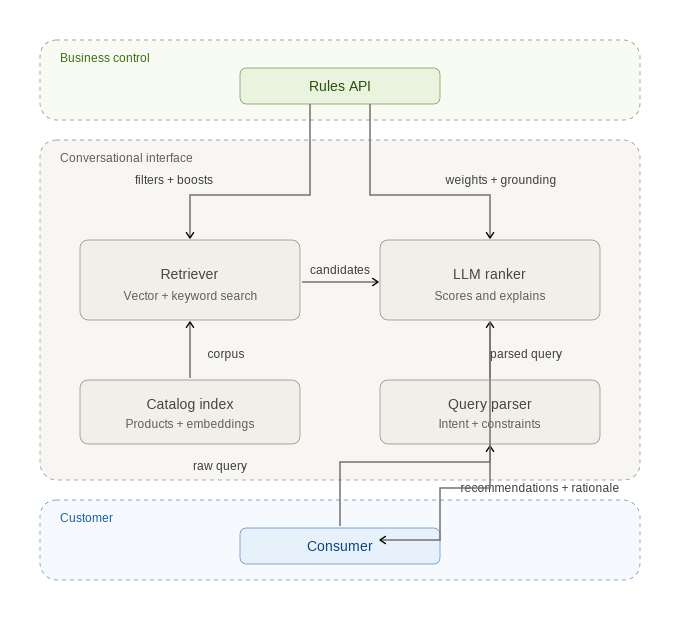
The buyer writes the rules. The API serves them on every query. The consumer sees the result — with no engineering in the path.
Inside the file, each rule is a few lines:
{
  "brand_boosts": [
    {
      "brand": "polo ralph lauren",
      "boost": 0.25,
      "reason": "Q1 2026 partnership campaign",
      "valid_from": "2026-01-01",
      "valid_until": "2026-03-31"
    },
    {
      "brand": "carhartt wip",
      "boost": 0.15,
      "reason": "Streetwear push — spring collection",
      "valid_from": "2026-03-01",
      "valid_until": "2026-05-31"
    }
  ],
  "category_boosts": [
    {
      "category": "t-shirt",
      "boost": 0.10,
      "reason": "Spring season — push lightweight items",
      "valid_from": "2026-03-01",
      "valid_until": "2026-06-30"
    }
  ]
}
The merchandiser saves the file. The next customer query reflects the change.
No prompt rewrite. No deploy. No ticket.
If changing the recommender requires an engineering cycle, it is not a control surface. It is a support channel.
Time-bound everything
Every rule carries valid_from and valid_until.
A campaign that runs January to March expires on its own. A spring push auto-sunsets in June. A partnership ends and stops influencing the assortment the moment the contract does.
Rules without expiry dates are how control surfaces rot. Six months in, an untagged boost is indistinguishable from a mistake — and no one remembers why it was added.
Time-bounding forces intent at write time. This rule exists, for this campaign, in this window.
Rules with null dates are the exception — reserved for permanent signals that encode brand identity, not promotion.
If a boost has no end date, someone should be able to explain why.
Nudge, don't override
The business score is one signal among several.
It sits alongside semantic relevance to the customer's query, popularity, behavioral signals, and price fit.
A product that does not match what the customer asked for will not appear in the results just because it carries a brand boost.
The merchandiser controls emphasis. The engine controls constraints.
This separation is deliberate.
If business rules could override everything, the result would be a promoted-products list pretending to be a recommendation engine.
If they had no influence at all, the merchandising team would route around the system — usually by asking engineering to change prompts, which is worse.
A shopping assistant the business cannot nudge is a shopping assistant the business will replace.
The audit trail has to live in the config
Every rule carries a reason string.
It is the smallest design decision in the file, and the one that saves the system six months later.
When someone asks "why are we still boosting Ralph Lauren?", the answer sits in the file next to the rule.
When the campaign ends, someone deletes the rule — because they can see what it was for.
Audit trails that live in Slack are audit trails that do not exist.
The reason field turns the config into a running log of every merchandising decision the system is currently acting on. Anyone on the team can open the file and see, in one place, what the recommender is being told to emphasise and why.
The same pattern covers every lever
The business team does not only want to boost brands.
The same config pattern extends across the levers that actually run retail.
- New arrivals — products added within the last N days get a configurable lift
- Discount visibility — products above a threshold get surfaced, proportional to the discount
- Price-tier targeting — items inside a specific price range get emphasis during a campaign
- Seasonal categories — a category push runs on its own time window and expires on its own
- Identity signals — permanent, date-less boosts that encode what the brand is
Each one is a few lines of JSON. Each one is time-bounded. Each one carries a reason.
A new merchandising lever becomes a pull request, not a project.
The vendor questions that actually matter
The common pattern in AI commerce vendors is the black box.
The catalog goes in. Recommendations come out. A dashboard reports aggregate metrics. What does not come with it is a control surface.
When the system does something unexpected, the business team files a support ticket and waits.
The shift is operational, not algorithmic:
- From prompt edits → to config saves
- From support tickets → to file modifications
- From quarterly roadmaps → to Friday deadlines
- From "which model does it use?" → to "can we change it by Friday?"
These are not cosmetic differences. They describe two different operating models.
The questions that matter when evaluating a vendor or an internal build:
- Can the merchandising team change what gets promoted by Friday?
- Can a new arrival be surfaced without a deploy?
- Can every active boost be traced to a reason and an expiry date?
- When a campaign ends, does its influence end with it?
If the answer to any of these is "not yet", the system being evaluated is a demo.
Control is the product
The word "control" has a bad reputation in AI circles.
It sounds like a fight with the model. A constraint on its intelligence.
In commerce, control is the product.
A conversational AI the business cannot steer is a conversational AI the business will turn off.
The model's intelligence is only useful inside a framework the merchandising team trusts, understands, and can change.
That is what production readiness actually means.
This is the second piece in a series on production GenAI for commerce. The first, What agentic commerce actually requires in production, covers the architectural argument. The engineering companion, Building a recommendation engine that doesn't trust the LLM, walks through the deterministic retrieval and scoring pipeline.
Upcoming pieces in the series cover how the same pattern handles multi-persona routing, and how merchandisers query the catalog in natural language — each written as a standalone piece rather than bundled here.
For a direct conversation on building or evaluating AI commerce systems — contact@artometrix.com.
Solutions
About the author

Cyril Noirot
Lead Data Scientist
Freelance data scientist. I design and ship decision systems — forecasting, pricing, marketing measurement, optimization.